Lunar Hydraulics: Water Reserves Limit Moon Cities to 10,000 Residents
Harvard and Durham researchers calculate that the moon's estimated water supply could sustain a small town for centuries, but only a small fraction of that population if extraction is efficient.
By Pedro Barnes ·
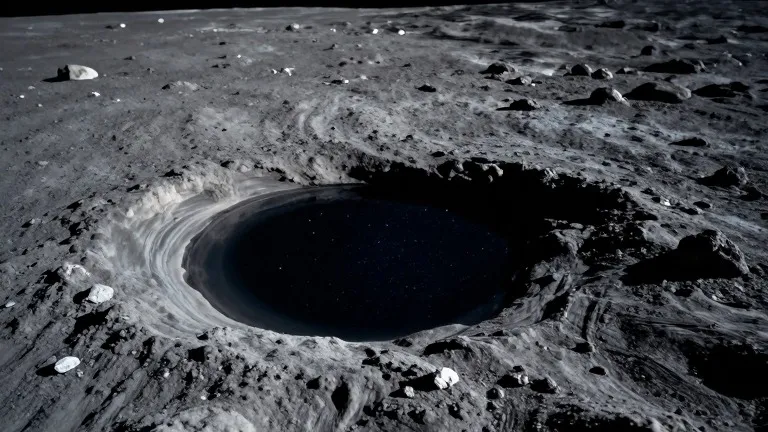
Water availability may be the primary constraint preventing the construction of large-scale lunar cities, according to a new study published in Frontiers in Space Technologies.
Martin Elvis, a senior astrophysicist at Harvard University's Smithsonian Astrophysical Observatory, and Jonathan McDowell, an honorary professor at Durham University's Space Research Centre, analyzed the feasibility of supporting large populations on the moon. Their research responds to public statements from tech leaders who have proposed ambitious timelines for lunar habitation. In February, SpaceX CEO Elon Musk stated that the company had prioritized building a self-growing city on the moon over Mars colonization, suggesting the project could be completed in under a decade. Blue Origin CEO Jeff Bezos has similarly claimed that millions of people will live in space by 2045.
The researchers determined that generating power for one million inhabitants is achievable through solar or nuclear means. However, the water supply presents a more difficult challenge. Most lunar water is located in permanently shadowed polar regions. The study assumes a total reserve of approximately one billion tonnes. Under this assumption, a population of one million people could survive for roughly a century if they recycle 98 percent of their water, a rate comparable to the International Space Station. Elvis described this volume as a small lake, noting that it would not supply a large city for an extended period.
A smaller settlement of 10,000 people would be sustainable for centuries under the same conditions. Elvis suggested that the initial estimate of one billion tonnes is likely too high, potentially overstating the available water by 20 or 30 times. If only one percent of that total is recoverable, the lifespan of a one-million-person city shrinks from 100 years to one. McDowell emphasized that while the moon lacks the water for sprawling metropolises, the findings do not discourage exploration.
Gordon Osinski, a professor of planetary geology at Western University in London, Ontario, noted that satellite measurements of lunar water contain uncertainties. He believes the water exists but requires ground confirmation. He compared the potential form of the water to Arctic permafrost, where sub-millimetre ice crystals are mixed into soil, making extraction difficult. The study concludes that while the moon's resources are limited, the specific location and quantity of usable water remain subjects of ongoing investigation.