North Korea’s Missile Threat Becomes More Lethal Through Russian Exchange
A new report details how Pyongyang is mass-producing drones and refining ballistic missile accuracy using data and labor swapped with Moscow.
By Leila Reynolds ·
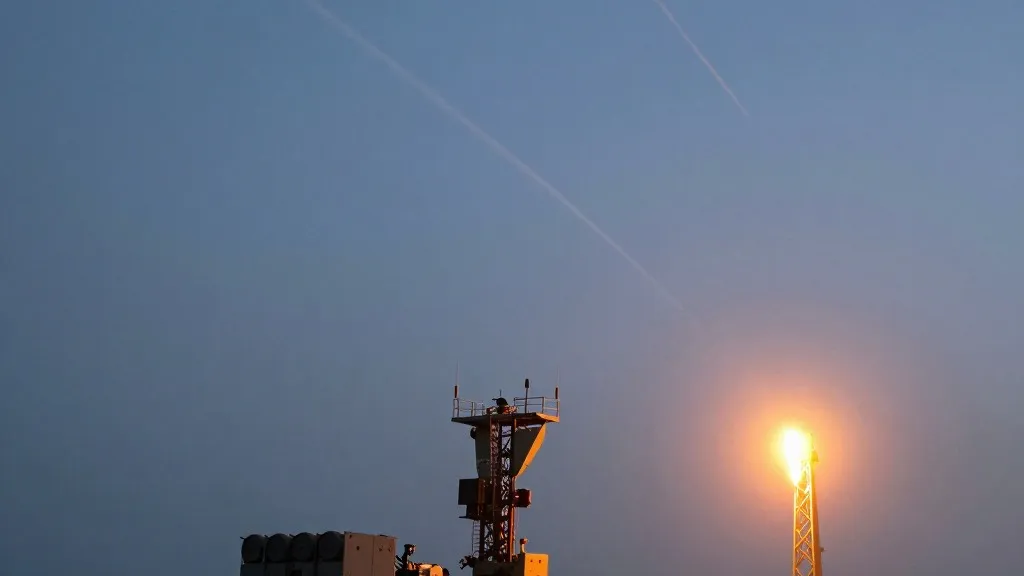
North Korea claims its latest tactical ballistic missile can travel 1,000 kilometers, a range that significantly exceeds the 700 kilometers estimated by its regional neighbors. This discrepancy highlights a growing concern in the region regarding the rapid advancement of Pyongyang's military capabilities. The figures come from a report by The New York Times, which details how North Korea is upgrading its arsenal and beginning mass production of attack drones. The driving force behind this surge in capability is a deepening cooperation with Russia.
The relationship between Moscow and Pyongyang has intensified since Russia launched its full-scale invasion of Ukraine. The two nations have renewed their military ties, creating a cycle of exchange. Russia provides North Korea with modern military developments and technical data. In return, Pyongyang supplies Moscow with soldiers, workers, and weapons. This reciprocal arrangement has allowed North Korea to modernize its armed forces and equipment at a pace that analysts say is altering the strategic balance in East Asia.
The recent missile test in early October serves as a prime example of this progress. Pyongyang stated that the tactical ballistic missile is capable of carrying a nuclear payload. While South Korea and Japan assessed the flight distance at approximately 700 kilometers, or 430 miles, the North Korean government insisted the range reached 1,000 kilometers, or 621 miles. This gap in perception underscores the opacity surrounding the North's testing programs and the difficulty in independently verifying its claims.
South Korea's response to the test was notably different from its usual protocol. Typically, Seoul issues short statements describing such launches as provocative. However, five days after the North's test, South Korea conducted its first test fire of a hypersonic ballistic missile. President Lee Jae Myung personally observed the launch. The New York Times characterized this move as a sign that Seoul is increasingly uneasy about the speed at which North Korea is advancing its missile technology.
A key factor in this technological leap is access to Russian deployment data and feedback. Anton Ponomarenko, an analyst, noted that this information has helped North Korea improve the accuracy and maneuverability of its weapons. He described the resulting threat to South Korea as more substantial than before. This technical transfer allows Pyongyang to refine its systems using real-world data from the Russian military, a resource that was previously less accessible.
Beyond missiles, Russia has assisted North Korea in building its own unmanned systems and producing them in large quantities. The New York Times reported that Pyongyang has observed how inexpensive drones can overwhelm costly air defense systems in Ukraine and the Middle East. In a military drill last month, North Korea demonstrated a new tactic. A swarm of drones attacked a target island while cruise and ballistic missiles struck from different directions simultaneously. This combined approach suggests a shift toward complex, multi-vector attacks.
The evolving tactics present significant challenges for South Korea and its allies. The newspaper argued that these developments will eventually force a redesign of air defense systems. Such upgrades are expected to come at an exorbitant cost, straining defense budgets in the region. The ability to launch coordinated attacks from multiple angles at a lower cost per unit is a strategic advantage that North Korea is increasingly leveraging.
This report follows other recent accounts of the Russia North Korea partnership. Bloomberg reported in September that Russia is using North Korean citizens to produce military drones, particularly at facilities in Alabuga, Tatarstan. It is believed that up to 25,000 North Koreans are working at Russian military plants. Additionally, a North Korean missile forces unit has begun deploying in western Russia. This unit could be equipped with 120 ballistic missiles and six launchers for strikes against Ukraine.
Previous reports have also highlighted the flow of equipment. Ukrainska Pravda noted that Russia asked North Korea in August to provide KN-30 ballistic missiles. In June 2026, North Korea announced tests of a modernized 240mm multiple-launch rocket system, a tactical ballistic missile, and a 155mm long-range artillery shell. These events collectively illustrate a sustained and deepening military integration between the two countries.