38% of Workers Use Thumbs-Up as Agreement, Survey Finds
Generational divides over the meaning of the emoji are causing friction in professional and personal digital communications.
By Ivan Dvorak ·
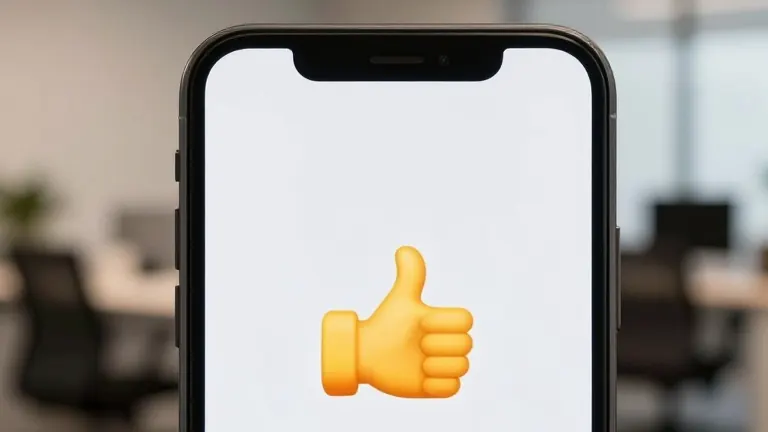
Office workers and friends are increasingly misinterpreting one of the most common digital responses. A single thumbs-up emoji, originally designed to signal agreement or approval, now carries a wide range of negative connotations depending on the recipient. For many younger users, the gesture appears cold, passive-aggressive, or sarcastic, while older colleagues often view it as a simple, efficient acknowledgment of a message.
The confusion stems from how the emoji flattens complex social interactions into a single data point. Lauren Gawne, a linguist who conducted research on the topic, explained that face-to-face communication offers many options, such as nodding, speaking, or acting. In digital spaces, these nuances are removed, leaving the thumbs-up open to subjective interpretation. Gawne noted that people bring their own specific meanings to this limited option.
A 2025 survey highlighted by Gawne found that 38% of workers use the thumbs-up reaction specifically to signal agreement. However, the survey also identified a growing number of younger employees who perceive the same gesture as dismissive. This generational gap creates a persistent source of anxiety in professional settings where clarity is expected.
Public examples illustrate the risk of misinterpretation. Singer Kelly Clarkson used the emoji on social media to criticize a New York City store, Art of Play, for not selling her a requested item. She wrote, “Sure, it wasn’t for sale. That’s the narrative Art of Play is gonna go with,” paired with the thumbs-up. In that instance, the symbol clearly conveyed sarcasm rather than approval. Conversely, a 35-year-old employee described on the subreddit IsThisUnprofessional believed he was being professional by using the emoji to mean “Got it, no notes, we’re good.” His younger colleague later told him the response read as cold, comparing it to a textual eye roll.
Etiquette expert Nick Leighton, host of the podcast “Were You Raised by Wolves?,” attributes these issues to a lack of clarity in digital communication. He stated that problems arise when assumptions fill the gaps left by ambiguous symbols. Leighton explained that in a work setting, the emoji often functions as a neutral acknowledgment. However, if a boss is known for passive-aggressive behavior, the same reaction may be viewed differently by the recipient.
The ambiguity worsens when the response is disproportionate to the original message. Leighton noted that a thumbs-up reply to a long, heartfelt paragraph can feel insufficient. Similarly, the ease of using the tap-back reaction on Apple devices can imply that a sender barely read the incoming text. A one-word text like “OK” or “sure” carries similar weight, suggesting a lack of effort that can make the sender feel uncertain about the recipient’s intent.
Leighton suggests adopting a pragmatic approach to reduce friction. He advised that people are rarely trying to be intentionally rude. Instead of analyzing every reaction for hidden meaning, individuals should assume the best intentions and treat the symbols as simple visual markers rather than complex emotional statements.