159 million at stake: Copacabana packed as Lula seeks unprecedented runoff win
President Lula rallies tens of thousands in Rio to challenge historical voting patterns in a tightly contested final day before the presidential vote.
By Pedro Barnes ·
Nearly 159 million Brazilian citizens hold the right to cast ballots on Sunday in a presidential runoff that promises to test the limits of recent electoral history. The contest is currently dead even in polling, following a first round held on October 4 where far-right candidate Flávio Bolsonaro captured 47% of the vote against incumbent President Luiz Inácio Lula da Silva’s 45%. This parity sets the stage for a decisive final weekend that could reshape the nation’s political trajectory.
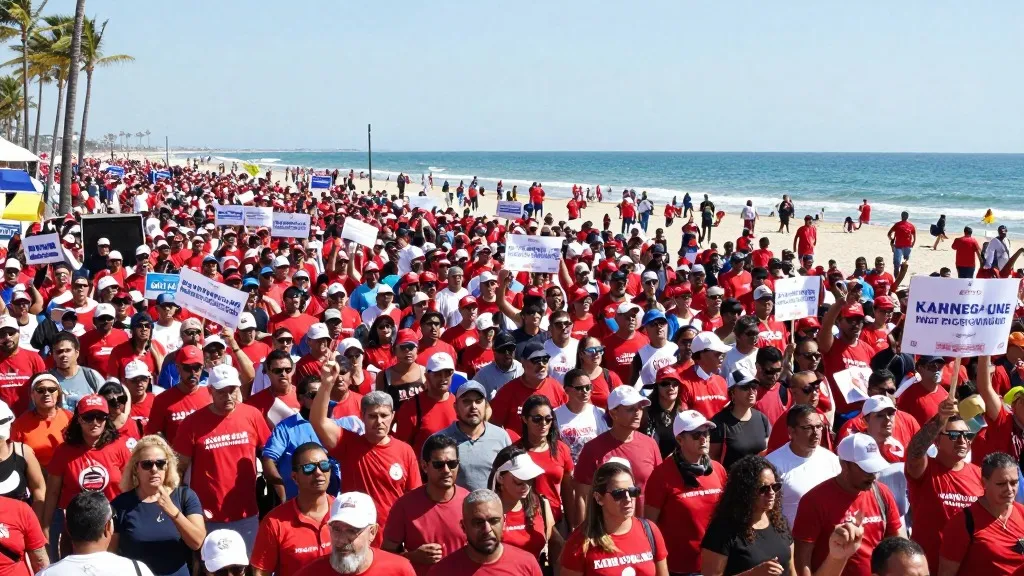
The stakes are particularly high because no candidate who lost the first round has successfully secured victory in the subsequent runoff since Brazil’s return to democracy in the 1980s. A win for Lula would therefore be a historic break from established precedent. To build momentum, tens of thousands of supporters descended on Copacabana beach in Rio de Janeiro on Saturday, creating a carnival-like atmosphere under the strong sun. The crowd, largely dressed in red, turned the 2.5-mile stretch of sand into a procession of activism and hope.
The energy on the beach was palpable, with activists unfurling banners and carrying handmade signs to project confidence. Josias Silva, a 61-year-old truck driver, held a sign declaring that tomorrow would be a new day for Lula. He argued that recent large-scale street protests, many driven by students, indicated that the populace had finally awakened. While Silva predicted a landslide victory of over 60% for the incumbent, most analysts view the race as significantly tighter, with Bolsonaro often cited as the slight favorite due to his name recognition and security platform.
Bolsonaro’s campaign has focused on confronting violent crime with a tough hand, leveraging the political legacy of his father, former President Jair Bolsonaro, who served from 2019 to 2022. However, Lula appears to have regained the initiative in recent days. This shift coincides with several scandals involving the opposition, most notably a report by the magazine Piauí claiming that Flávio Bolsonaro attended a boat party with sex workers and vaccine lobbyists during the peak of the 2020 coronavirus outbreak. Such revelations have complicated the challenger’s image just before the final vote.
For many voters, the election feels like a referendum on the future of Brazilian democracy rather than a standard political choice. Jair Bolsonaro is currently serving a 27-year prison sentence for plotting a coup after losing the 2022 election. There is widespread fear among democrats that a victory for his son could lead to the elder Bolsonaro’s release or even his return to government. Reports suggest that other jailed or exiled plotters might receive senior military and police appointments under a Bolsonaro administration. Marta Moraes, a 59-year-old restaurateur, expressed opposition to this specific political movement rather than the right wing in general, citing personal losses during the pandemic as a motivating factor.
The mobilization efforts have been extensive, with many participants belonging to "Lula's Army," a WhatsApp group that has grown to 10 million members since the first round. Isabella Gaze, a retired teacher, described the event as anything but a normal election. Others, like DJ and activist Cammy Marinho, spent the previous two weeks actively persuading Bolsonaro voters and abstainers to switch sides. The dedication was visible in attendees like Heitor Lopes da Silva, a 14-year-old who traveled from Duque de Caxias in his wheelchair carrying a placard of support.
On the other side of the political divide, Bolsonaro’s backers also mobilized, with thousands gathering in Belo Horizonte, the capital of Minas Gerais. Wearing yellow jerseys and waving Brazilian and US flags, supporters emphasized the security message of the campaign. Antonio Carlos Costa Jr, a shooting club owner, argued that the former president’s gun laws empowered citizens to defend themselves. Although security experts note that those laws diverted firearms to criminal gangs and that Lula has since tightened regulations, Bolsonaro’s supporters remain committed to his platform. The state is a critical bellwether, as no candidate has won the presidency without carrying it, and Bolsonaro leads there by nearly 5%.
The final day of campaigning has thus become a clash of narratives: one side pushing for a historic comeback to stabilize democracy, and the other rallying around security and continuity. With polls showing a narrow margin, every vote in the 159 million eligible electorate will matter in determining whether Lula becomes the first first-round loser to win a runoff or if Bolsonaro breaks the cycle.
More Politics · World news · Report a business · Got a Story?