Mars Morning Cloud: New Model Reveals Extreme Humidity Requirement
Researchers at Sorbonne Université propose that the Arsia Mons Elongated Cloud forms via a rare ice nucleation process never directly observed in planetary atmospheres.
By Pedro Barnes ·
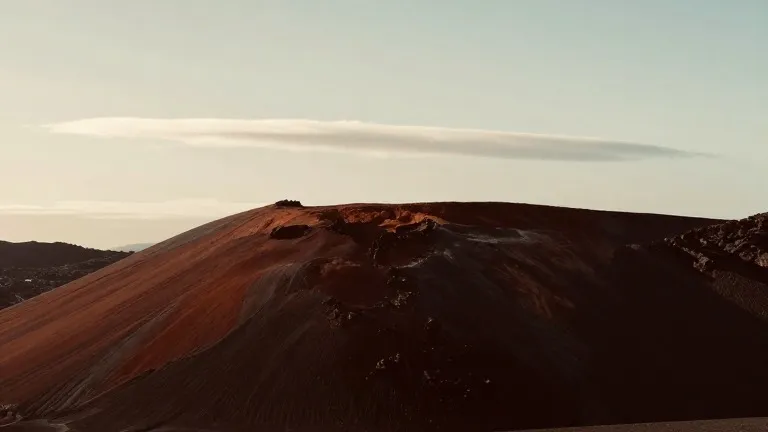
A new computer model published in Nature Geoscience has reproduced the formation of the Arsia Mons Elongated Cloud, a vast feature that appears near Mars each morning during spring and summer. The study, led by planetary scientist Jorge Hernández-Bernal at Sorbonne Université, suggests the cloud relies on a physical mechanism previously thought to be purely theoretical.
The AMEC, first recorded by a probe in 2018, stretches over 1,000 miles, a distance comparable to the straight-line span from New York to Kansas City. It grows gradually throughout the morning and dissipates by midday, a cycle that repeats over several months. Scientists have struggled for years to explain how such a large feature forms and disappears so predictably.
Standard cloud physics on Earth involves water vapor condensing around dust or salt particles. The new model proposes a different process for Mars: homogeneous nucleation. In this scenario, water vapor turns directly into ice crystals without any external debris to seed the formation. Hernández-Bernal described the concept as akin to condensation appearing in the middle of a room rather than on a window surface.
The simulations only produced a result matching the observed cloud size and duration when the researchers included what Hernández-Bernal termed exotic physics. This process requires extreme local conditions, specifically a temperature drop of 30 degrees Celsius within 10 minutes and exceptionally high relative humidity. The 65,000-foot Arsia Mons volcano drives this process by creating powerful wind waves that lift moist air rapidly into the upper atmosphere.
The humidity levels required for this formation are estimated to be more than 100,000 times greater than any values measured on Earth. This extreme threshold may explain why the phenomenon has not been directly observed in other planetary atmospheres, including those of Venus or Earth, despite long-standing assumptions that similar nucleation could occur in upper atmospheric layers.
Hernández-Bernal noted that the Martian atmosphere remains poorly mapped compared to Earth's. The ability to replicate the cloud's specific characteristics in a model suggests that current understanding of Martian weather patterns is incomplete. The findings indicate that the physical conditions necessary for such large-scale morning clouds are far more extreme than previously modeled.
The research team stated that the successful replication of the AMEC validates the inclusion of homogeneous nucleation in future atmospheric models. The study provides a concrete physical explanation for the cloud's lifecycle, resolving a long-standing question in planetary science.